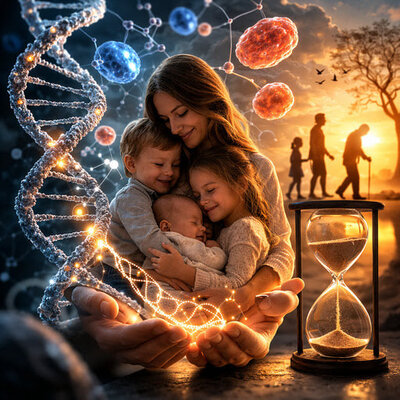
The Surprising Impact of childbearing on biological aging
Have you ever wondered how family size changes your lifespan? Scientists continuously study human longevity. Numerous factors affect how fast we age. Our environment shapes our health daily. Furthermore, our DNA plays a massive role in our overall lifespan. Recently, researchers discovered a fascinating connection. A new study from the University of Helsinki reveals the Impact of childbearing on biological aging. The researchers found that having many children directly links to faster cellular aging. Moreover, having zero children also connects to a significantly shorter lifespan. Conversely, having two or three children offers the absolute best health outcomes. Consequently, many parents want to thoroughly understand this complex relationship. We know that nothing matters more than the well-being of your entire family. Therefore, providing accurate, science-based health information helps everyone make better life choices. This article will explore the exact biological mechanisms behind these historical findings. First, we will examine the historical cohort data. Next, we will look at modern evolutionary biology theories. Finally, we will discuss what this means for modern parents today. Understanding this research empowers families to prioritize their long-term health effectively. The varying effects of reproduction on cellular degradation constantly fascinate medical professionals globally. Thus, exploring the biological consequences of parenthood provides incredible value.
Analyzing the Impact of childbearing on biological aging
To truly grasp the Impact of childbearing on biological aging, we must carefully analyze the specific study methods. The research team did not just guess these health outcomes. Instead, they meticulously analyzed detailed data from exactly 14,836 women. Importantly, all of these specific women were twins. The team strategically used twins to minimize confusing genetic factors. Thus, they created a highly accurate picture of mortality and overall childbearing history. Next, the scientists separated the participants into different analytical groups. They based these distinct groups on the total number of live children each woman delivered. Additionally, they carefully considered the exact timing of the pregnancies. The health statistics clearly showed a distinct U-shaped curve. Women with average family sizes of two to three children displayed the lowest mortality risks. Moreover, women who gave birth roughly between the ages of 24 and 38 aged the absolutely slowest. However, women with an average of 6.8 children aged much faster. These numbers provide concrete evidence for the physical toll of extreme reproductive patterns. The Impact of childbearing on biological aging becomes undeniable when looking at such massive datasets. Scientists consistently see these patterns emerging in various longevity studies. Therefore, tracking the physical changes caused by pregnancy remains extremely vital.
Evolution and the Impact of childbearing on biological aging
How does nature perfectly explain this strange phenomenon? Scientists actively use evolutionary biology to understand the Impact of childbearing on biological aging. Specifically, they rely heavily on the famous disposable soma theory. This theory suggests that organisms possess highly limited resources. For example, the body only has so much time and physical energy. Therefore, our lives represent a constant, delicate balance between reproduction and basic survival. If a body invests heavily in reproduction, it leaves far fewer resources for bodily maintenance. Consequently, having many children literally drains vital energy from essential DNA repair mechanisms. This massive energy drain directly reduces overall cellular lifespan. Mikaela Hukkanen, a prominent biologist, strongly states that this biological trade-off is completely logical. Natural selection might actually favor much earlier reproduction. Nature prefers shorter generation times, even if it creates severe health costs associated with aging. Thus, the physical cost of large families deeply roots itself in our evolutionary history. Nature constantly forces the human body to choose between producing offspring and repairing its own cells. As a result, parents often sacrifice their own physical resources for their babies. Understanding the evolutionary consequences of having children changes how we view human health completely.
Childfree Anomaly in the Aging Curve
The evolutionary theory perfectly explains why large families severely accelerate aging. However, it completely fails to explain the other side of the demographic curve. Why exactly did childfree women also show much faster cellular degradation? The disposable soma theory simply does not explain why having zero children links directly to poorer health outcomes, heavily complicating the Impact of childbearing on biological aging. The study authors freely admit this specific finding is quite surprising. Nevertheless, researchers confidently offer several logical explanations. First, unmeasured variables likely heavily influenced these specific historical results. For instance, severe pre-existing medical conditions might have naturally prevented pregnancy and simultaneously shortened lifespan. Furthermore, remaining voluntarily child-free was far less common historically. Therefore, childlessness often indicated serious underlying health struggles rather than a simple modern lifestyle choice. Additionally, we must constantly consider the incredibly protective elements of parenthood. Some aspects of normal pregnancy actually lower the direct risk of certain severe cancers. For example, routine breastfeeding actively lowers the risk of breast and ovarian cancer. Moreover, children often provide essential social caregiving to their parents later in life. Without this vital family support, aging adults might independently face much higher mortality risks.
Measuring Epigenetic Changes from Pregnancy
Modern science allows researchers to accurately measure aging long before visible physical signs appear. They highly utilize complex epigenetic tools for this incredibly difficult task. The Finnish Twin Cohort project provided vital, physical blood samples for this advanced analysis. Scientists thoroughly assessed a smaller subset of 1,054 participants for specific markers of biological aging. They quickly discovered that life history choices leave a permanent, lasting biological imprint. Extremely high reproduction rates closely associated with significantly faster epigenetic aging. Epigenetic aging directly refers to permanent changes in how the body physically expresses DNA later in life. Epigeneticist Miina Ollikainen emphasizes heavily that biological age often matters far more than simple calendar age. If you are biologically older than your calendar age, your personal death risk significantly increases. Interestingly, having a child at a extremely young age also linked initially to faster aging. However, this specific statistical difference mostly disappeared completely after researchers carefully controlled for modern lifestyle factors. Things like total body mass index and daily alcohol consumption heavily influenced the early-age statistics. This ultimately proves that daily lifestyle choices strongly interact with our fundamental reproductive biology. The true Impact of childbearing on biological aging deeply results from a complex mix of genetics and environment.
Modern Healthcare and Family Choices
We absolutely must carefully interpret this fascinating historical data. The expansive study specifically focused on women born entirely between 1880 and 1957. These incredibly resilient individuals lived through devastating world wars and severe social upheavals in Finland. Consequently, their daily life circumstances vastly differ from people actively becoming pregnant today. Modern families consistently enjoy dramatically better daily nutrition, highly advanced medicine, and superior social support systems. Therefore, the Impact of childbearing on biological aging might logically look fundamentally different in today’s modern world. Medical experts emphasize strongly that this historical study does not provide direct individual health advice. Women absolutely should not ever change their personal family plans based on these extremely specific findings. Instead, doctors can intelligently use this valuable information to develop significantly better public health strategies. Incredible new medical tools now allow us to precisely measure pregnancy impacts on much shorter timescales. This incredibly exciting technological advancement powerfully opens the door for extremely clear pathways to early medical interventions. By actively focusing on holistic baby and kids health, we effectively protect the entire connected family unit. Healthy, thriving children naturally grow alongside healthy, well-supported parents. Ultimately, while the Impact of childbearing on biological aging is a documented scientific reality, proactive modern healthcare easily manages it.
The following post may interest you
When Moms Say Bad Words: Impact on Children and Society
Source
Epigenetic aging and lifespan reflect reproductive history in the Finnish Twin Cohort