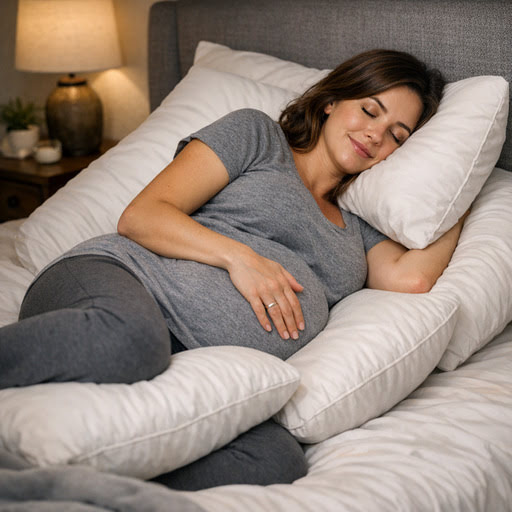
The Ultimate Guide to the Best sleeping positions for pregnancy
Achieving quality rest is a major challenge for expectant mothers. However, identifying the Best sleeping positions for pregnancy is crucial. In fact, it supports both maternal well-being and fetal development. Sleep is not merely a pause in your day; rather, it is a critical physiological state. For instance, during sleep, your body repairs blood vessels and regulates insulin. Additionally, it supports the immune system. Consequently, these functions are vital when you are growing a new life.
Nevertheless, pregnancy brings physical changes. Specifically, an expanding abdomen and hormonal fluctuations can occur. Furthermore, back pain and shortness of breath may make comfort nearly impossible. Therefore, this guide synthesizes the latest medical research and expert advice. It will help you understand and adopt the Best sleeping positions for pregnancy. Ultimately, this ensures you and your baby remain safe and healthy.
The Science Behind Safe Sleep During Pregnancy
Understanding the science behind safe sleep shifts the focus to safety. Notably, the anatomy of a pregnant body changes drastically. This is particularly true for the circulatory system. First and foremost, the most critical factor for safety is the inferior vena cava (IVC). Specifically, this large vein runs parallel to the spine on the right side. It transports deoxygenated blood from your lower body back to your heart.
As the uterus grows heavy over time, it can compress this vein if you lie flat on your back. As a result, this compression compromises blood circulation. Subsequently, it can lead to supine hypotensive syndrome. Symptoms include dizziness, low blood pressure, and nausea. More critically, this restricts oxygen and nutrients to the placenta. Therefore, the Best sleeping positions for pregnancy mechanically prevent this compression. Thus, fetal oxygenation remains optimal during sleep.
The “SOS” Method: The Gold Standard
Medical professionals almost universally recommend the “SOS” (Sleep on Side) position. Indeed, it is the gold standard for the Best sleeping positions for pregnancy. Furthermore, this posture is clinically proven to optimize blood flow. Sleeping on your side offloads the uterus weight. Simultaneously, it removes pressure from the inferior vena cava and liver. Consequently, this facilitates unrestricted circulation.
Left Side vs. Right Side Benefits
Any side-sleeping posture is better than back sleeping. However, the left side is often highlighted as ideal. For example, positioning yourself on the left moves the uterus away from the liver. In addition, it moves it away from the IVC. Thus, this maximizes blood flow to the uterus, kidneys, and fetus. Moreover, adopting this position aids the kidneys. Specifically, they can efficiently eliminate waste and fluids. As a result, this reduces pregnancy-related swelling in the ankles and feet. Conversely, if the left side is uncomfortable, the right side is still excellent. It is certainly a safe variation and far better than supine sleeping.
Adjusting Your Sleep Posture by Trimester
Pregnancy involves distinct stages. Accordingly, the definition of optimal sleep evolves as your body changes. For instance, what works in week 8 might be impossible in week 30.
Sleeping Postures in Early Pregnancy (First Trimester)
In the first trimester, the uterus is still relatively small. Also, it is protected within the pelvis. Therefore, strict adherence to specific positions is less critical now. In fact, you may continue to sleep on your stomach or back if comfortable. However, hormonal changes might make your breasts tender. Consequently, this can make stomach sleeping uncomfortable early on. Thus, experts suggest using this time to train your body. Ultimately, adopting side sleeping now makes the transition smoother later.
Mid-Pregnancy Sleeping Adjustments (Second Trimester)
In the second trimester, the uterus expands out of the pelvis. Hence, prioritizing the Best sleeping positions for pregnancy becomes essential. You will likely stop sleeping on your stomach naturally. After all, the bump simply gets too big. Additionally, this is when supine sleep begins to pose risks. Therefore, consciously choosing a side-lying position now helps prevent dizziness. Furthermore, it ensures the placenta receives maximum blood flow. This is vital as the baby grows rapidly.
Late Pregnancy Sleeping Essentials (Third Trimester)
Finally, the third trimester is critical for safety. For instance, research shows stillbirth risk may increase with back sleeping. Specifically, this applies to pregnancies after 28 weeks. The full-term uterus is very heavy. Consequently, this makes strictly side-lying positions non-negotiable. Notably, this advice applies to all sleep episodes. It includes nighttime sleep and daytime naps.
Risks of Supine Sleep
You must understand the risks of ignoring these guidelines. This is particularly true for supine (back) sleep.
Impact on Fetal Heart Rate
Studies have used fetal heart rate monitoring. Significantly, they show that back sleeping affects the fetus. For example, the fetus may experience heart rate decelerations. Also, it may enter a quiescent state. This is likely an adaptive response to reduced oxygen. Admittedly, a healthy fetus can tolerate brief stress. However, prolonged supine sleep removes safety margins. Therefore, adopting the Best sleeping positions for pregnancy eliminates this stress.
Maternal Health Consequences
Avoiding optimal positions can also exacerbate Sleep-Disordered Breathing (SDB) for the mother. For instance, back sleeping increases the likelihood of snoring. Additionally, it risks obstructive sleep apnea due to gravity. Unfortunately, untreated sleep apnea is linked to serious complications. These include preeclampsia, gestational hypertension, and low birth weight. Thus, side sleeping keeps the maternal airway open.
Practical Tips for Maintaining Side Sleep
Knowing the theory is different from practice. In reality, many women struggle to stay on their side. Here are therefore strategies to maintain these positions comfortably.
Using Pillows for Optimal Support
Pillows are essential tools for comfort.
- The Wedge: First, place a wedge pillow under your baby bump. This supports its weight. Moreover, it prevents the “pulling” sensation that disrupts sleep.
- Leg Support: Next, keep your knees and legs bent. Place a thick pillow between your legs. This aligns the hips and reduces lower back strain. As a result, it makes side sleeping sustainable for hours.
- Back Buffer: Finally, a crucial trick is placing a firm pillow behind your back. You might roll backwards during sleep. However, this buffer keeps you on a tilt. Thus, it prevents you from ending up flat on your back.
Managing Common Discomforts
Issues can arise even in the Best sleeping positions for pregnancy.
- Symphysis Pubis Dysfunction (SPD): Side sleeping can be painful with pelvic pain. To make it work, keep your legs parallel. Importantly, do not let the top leg drag the hip down.
- Heartburn: Similarly, side sleeping might trigger heartburn. In this case, try propping your upper body up with pillows. Maintain a side tilt while doing so.
Addressing Anxiety and Nighttime Waking
Fear of waking up on the back is a common stressor. Therefore, approach sleep with a mindset of risk reduction. Above all, do not aim for perfection.
The “Going to Sleep” Principle
The position you fall asleep in matters most. Usually, you spend the most time in that position. Therefore, start your night in one of the Best sleeping positions for pregnancy. However, if you wake up on your back, do not panic. Waking up is often a protective mechanism. Simply roll back onto your side. Remember, the goal is the total time spent on the side. In short, brief moments on the back are usually fine. They are not cause for alarm in a healthy pregnancy.
Conclusion: Prioritizing Rest and Safety
Navigating sleep during pregnancy balances comfort and safety. By prioritizing the Best sleeping positions for pregnancy, like the “SOS” position, you take a powerful step. Indeed, you protect your unborn child. Admittedly, transitioning away from back sleeping can be difficult. However, supportive pillows can help. Furthermore, understanding the benefits makes the process easier. So, trust your body. Minimize anxiety by focusing on your starting position. Ultimately, adopting safe sleep habits is a great gift for your developing baby.
The following post may interest you
Pregnancy Weight Gain: Insights and Strategies
Optimal Nutrition During Pregnancy
Sources
“Sleep on side”: Awareness and anxiety around sleeping position during late pregnancy
https://www.sciencedirect.com/science/article/pii/S1871519225002550
Typical Sleep Positions in Pregnant People
https://pmc.ncbi.nlm.nih.gov/articles/PMC4005859/pdf/nihms-576100.pdf
A Position Modification Device for the Prevention of Supine Sleep During Pregnancy: A Randomised Crossover Trial
https://obgyn.onlinelibrary.wiley.com/doi/pdf/10.1111/1471-0528.17952
Modifying Maternal Sleep Position in Late Pregnancy Through Positional Therapy: A Feasibility Study