Childhood Vaccination Schedule: Key Facts at a Glance
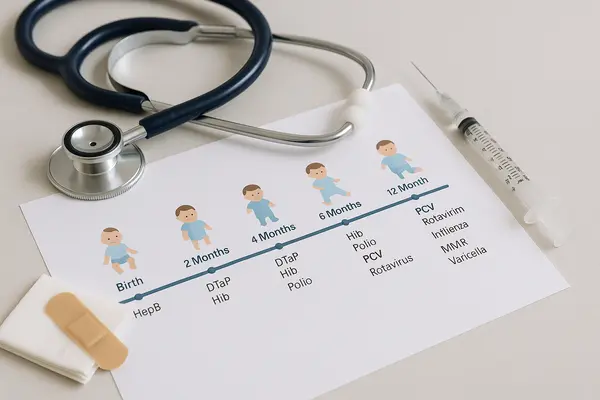
This article outlines the U.S. CDC immunization schedule. Vaccines begin at birth with hepatitis B, continue with several vaccines at 2, 4, and 6 months, and include further doses at 12 to 15 months and boosters at 4 to 6 years. Recommendations evolve, so work closely with your child’s healthcare provider.
- At birth: First dose of hepatitis B (HepB). The second dose is at 1 to 2 months and the third at 6 to 18 months.
- At 2, 4, and 6 months: DTaP (diphtheria, tetanus, pertussis). Polio (IPV), Hib, pneumococcal (PCV), and rotavirus vaccines also begin at 2 months.
- At 12 to 15 months: First doses of MMR (measles, mumps, rubella) and varicella (chickenpox). Hepatitis A is a two-dose series between 12 and 23 months.
- At 4 to 6 years: Boosters for DTaP, IPV, MMR, and varicella before starting school.
- Adolescents: Additional vaccines such as Tdap, HPV, and meningococcal.
- Missed doses: A catch-up schedule can be created with your healthcare provider.
- Alternative schedules: They are not supported by scientific evidence and can leave children unnecessarily exposed to preventable diseases.
- What Is the Schedule for Childhood Vaccinations?
- Why Vaccination Timing Matters
- Key Vaccination Milestones by Age
- Beyond the Basics: Special Considerations
- Final Thoughts: Building a Healthier Future
What Is the Schedule for Childhood Vaccinations?
Ensuring your child receives timely immunizations is essential for preventing serious illnesses. Parents often ask, what is the schedule for childhood vaccinations, especially as recommendations evolve. In this article, we provide a detailed guide to the U.S. Centers for Disease Control and Prevention (CDC) immunization schedule. Additionally, we integrate global insights and key scientific research findings to enhance understanding.
Why Vaccination Timing Matters
Adhering to the schedule for childhood vaccinations reduces the risk of vaccine-preventable diseases like measles, polio, and whooping cough. In fact, children who receive vaccinations on time are significantly less likely to suffer from severe disease complications. Moreover, staying on schedule helps protect vulnerable groups through the concept of herd immunity. Therefore, timely vaccination is not just a personal health matter—it’s a public health priority.
Key Vaccination Milestones by Age
Birth to 6 Months
- Hepatitis B (HepB): First dose at birth, second at 1–2 months, third at 6–18 months.
- DTaP (Diphtheria, Tetanus, Pertussis): Administered at 2, 4, and 6 months.
- Polio (IPV): Given at 2, 4, and 6–18 months.
- Hib and Pneumococcal (PCV): Begin at 2 months.
- Rotavirus (RV): Administered at 2 and 4 months (2-dose series) or 2, 4, and 6 months (3-dose series).
6 Months to 18 Months
- Booster doses of DTaP, Hib, PCV, and IPV are crucial during this period.
- MMR (Measles, Mumps, Rubella): First dose at 12–15 months.
- Varicella (Chickenpox): First dose at 12–15 months.
- Hepatitis A (HepA): Two-dose series between 12–23 months.
4 to 6 Years
- At this stage, children receive boosters for DTaP, IPV, MMR, and Varicella vaccines. These strengthen their immunity before starting school.
Beyond the Basics: Special Considerations
Adolescent and Catch-Up Vaccinations
As children grow, their immunization needs evolve. They may require additional vaccines such as Tdap, HPV, and Meningococcal (MenACWY and MenB). Fortunately, if a child missed earlier doses, a catch-up schedule can be created with their healthcare provider.
Global Perspectives on Vaccine Timing
Countries adapt their vaccine schedules based on local health needs. For example, the UK includes BCG for tuberculosis and implements school-based immunization programs. Understanding these differences underscores the importance of following national guidelines. Furthermore, these comparisons highlight how global health strategies can inform local practices.
Consequences of Delayed Vaccination
Delays in vaccination increase vulnerability to outbreaks and reduce public health protections. These delays are often linked to misinformation, logistical challenges, or healthcare access issues. Consequently, parents and caregivers should prioritize completing vaccinations on time.
Parental Beliefs and Vaccine Hesitancy
Parental trust in vaccines plays a crucial role in timely immunization. While many rely on healthcare professionals, the influence of social media and misinformation has contributed to hesitancy. Therefore, education and open dialogue are key to addressing concerns and promoting vaccine confidence.
Alternative Schedules and Medical Advice
Some parents consider alternative vaccination schedules. However, such approaches are not supported by scientific evidence and can leave children unnecessarily exposed to preventable diseases. Thus, following the recommended schedule remains the safest approach.
Tools to Track and Manage Vaccinations
In today’s digital age, parents have access to helpful tools. Digital apps, mobile reminders, and state immunization registries offer practical ways to monitor a child’s vaccination status. These resources empower parents to stay on schedule and ensure complete coverage.
Final Thoughts: Building a Healthier Future
Following what is the schedule for childhood vaccinations is one of the most effective steps parents can take to protect their child’s health. Not only does timely immunization shield individual children, but it also strengthens community health overall. To achieve this, stay informed, work closely with your child’s healthcare provider, and take advantage of available resources to maintain a complete and up-to-date vaccination record.
The following post may interest you
What Are the Side Effects of Vaccines in Babies?
What Vaccines Does My Baby Need?
Disclaimer: The content provided on BabyKidsHealth.com is for informational purposes only and is not intended as a substitute for professional medical advice, diagnosis, or treatment. Always seek the advice of your physician or other qualified health provider with any questions you may have regarding a medical condition.
Sources
Recommended Vaccines for Young Children (Centers for Disease Control and Prevention, CDC)
https://www.cdc.gov/vaccines/imz-schedules/child-easyread.html
Vaccine Schedules (Centers for Disease Control and Prevention, CDC)
https://www.cdc.gov/vaccines-children/schedules/index.html
All About the AAP Recommended Immunization Schedule (American Academy of Pediatrics, HealthyChildren.org)
Childhood Vaccination Implications for Global and Domestic Public Health
https://www.academia.edu/download/78844372/Attachment_20I.pdf
Reasons for delayed compliance with the childhood vaccination schedule and some failings of computerised vaccination registers
https://www.sciencedirect.com/science/article/pii/S1326020023025542
Health Information Sources, Perceived Vaccination Benefits, and Maintenance of Childhood Vaccination Schedules
https://www.tandfonline.com/doi/abs/10.1080/10410236.2018.1481707