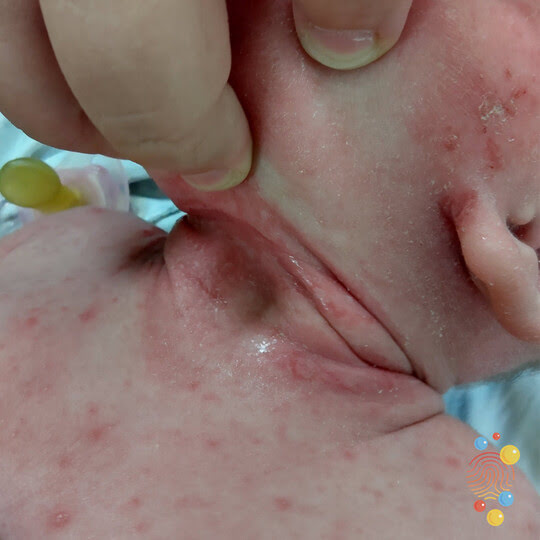
Intertrigo in Babies: Key Facts at a Glance
Intertrigo is a common inflammatory rash that develops in a baby’s skin folds, where skin rubs against skin. It is caused mainly by friction, warmth, and trapped moisture, and it is generally harmless and clears up quickly with proper skin care.
- Daily care: Wash the folds twice daily with warm water and a soap-free, fragrance-free cleanser, without scrubbing, and dry the skin fully.
- Barrier: A zinc oxide barrier paste protects raw skin and relieves chafing.
- Neck folds: Manage moisture from drool and spit-up with soft cotton bibs, and replace them as soon as they are damp.
- Clothing and diapers: Fasten diapers loosely, change wet or soiled diapers right away, and dress your baby in lightweight, breathable cotton.
- What to avoid: Do not use talcum powder because of inhalation risks, and avoid cornstarch, which can feed yeast.
- If it is infected: A doctor may prescribe an antifungal or antibacterial cream. With the correct cream, improvement is visible within 48 to 72 hours.
- Room temperature: Keep the nursery between 20°C and 22°C to limit sweating.
- Comprehensive Clinical Guide to Intertrigo in Babies
- Pathophysiology and Mechanisms of Intertrigo in Babies
- Identifying Clinical Features and Locations of Intertrigo in Babies
- Differentiating Simple Erythema Intertrigo from Complex Infections
- Evidence-Based Intertrigo Treatment Protocols
- Proactive Prevention and Daily Care Routines
- Frequently Asked Questions
- Scientific Sources
Comprehensive Clinical Guide to Intertrigo in Babies
Understanding intertrigo in babies is an essential aspect of pediatric dermatological care because infant skin is uniquely delicate, structurally thin, and exceptionally prone to mechanical irritation. Intertrigo in babies represents a superficial inflammatory dermatosis that arises within flexural locations where adjacent skin surfaces continuously rub against one another. In clinical practice, intertrigo in babies develops primarily due to friction, warmth, and trapped moisture accumulating within anatomical creases. Because infant anatomy features short necks, prominent fat rolls, and a naturally flexed resting posture, intertrigo in babies can manifest rapidly across the diaper region, axillae, and cervical folds. Managing intertrigo in babies requires a structured approach that prioritizes moisture control, gentle cleansing, barrier enhancement, and prompt medical intervention when secondary microbial superinfections complicate simple intertrigo in babies.
Pathophysiology and Mechanisms of Intertrigo in Babies
To effectively address intertrigo in babies, caregivers and medical practitioners must understand how infant physiology contributes to mechanical skin breakdown.
- Frictional Microtrauma: The continuous rubbing of opposing cutaneous folds creates micro-abrasions in the fragile stratum corneum.
- Trapped Perspiration and Fluids: Sweat, drool, milk spit-up, and localized secretions remain trapped within occluded flexural folds where ambient air cannot circulate.
- Maceration of the Cutaneous Barrier: Prolonged moisture exposure softens keratinocytes, leading to epidermal maceration, transepidermal water loss, and loss of protective integrity.
- Microbial Proliferation: Flexural environments exhibit elevated surface temperatures and alkaline shifts that encourage commensal organisms like Candida albicans to transition into opportunistic pathogens.
Identifying Clinical Features and Locations of Intertrigo in Babies
The clinical manifestations of intertrigo in babies range from mild, symmetrical pinkish patches to deep, painful, weeping erosions.
Common Anatomical Sites
- Deep Cervical Folds: The anterior and lateral neck creases are heavily exposed to persistent drooling and milk regurgitation.
- Inguinal and Perineal Creases: Moisture from urine, digestive enzymes in feces, and occlusive diapers create prime conditions for diaper-associated intertrigo in babies.
- Axillary Vaults: The armpits experience constant friction during upper limb movements while trapping sweat.
- Antecubital and Popliteal Spaces: The inner elbow and knee folds rub together constantly during regular infant leg kicks and arm flexions.
- Thigh and Wrist Rolls: Chubby skin rolls on the thighs and wrists of healthy, well-nourished infants trap moisture and accumulate lint.
| Clinical Stage | Pathological Characteristics | Physical Symptoms and Visible Signs | Immediate Action Required |
| Stage 1: Mild Erythema | Early friction and localized surface irritation | Symmetrical, mirror-image pinkish-red patches without skin breakage | Gentle cleansing, complete drying, and breathable cotton clothing |
| Stage 2: Maceration & Chafing | Persistent moisture trapping causing tissue breakdown | Softened, peeling skin, stinging, fussiness, and shallow skin cracks | Application of zinc oxide or petrolatum-based barrier ointments |
| Stage 3: Secondary Superinfection | Microbial colonization by fungi or bacterial pathogens | Bright red plaques, satellite pustules, weeping tissue, or foul odor | Targeted physician-prescribed antifungal or antibacterial therapy |
Differentiating Simple Erythema Intertrigo from Complex Infections
Uncomplicated erythema intertrigo is purely mechanical, but the compromised skin barrier frequently permits opportunistic pathogens to invade.
Secondary Fungal Superinfections
When Candida albicans colonizes irritated folds, the condition transitions into candida intertrigo (also documented clinically as candidal intertrigo or intertrigo candida). In pediatric populations, candidal intertrigo in babies is characterized by vivid, beefy-red confluent plaques with sharp, scalloped borders and small, distinct peripheral satellite papules or pustules.
Secondary Bacterial Superinfections
Bacterial invasion involves organisms such as Staphylococcus aureus, Group A Beta-Hemolytic Streptococcus (GABHS), or Gram-negative bacilli like Pseudomonas aeruginosa. Streptococcal intertrigo presents as a deep, fire-engine red, weeping erosion accompanied by a distinct foul odor and the absence of typical satellite pustules.
| Condition Entity | Primary Causative Factor | Key Diagnostic Visual Features | Preferred Interventional Approach |
| Simple Erythema Intertrigo | Mechanical friction, trapped sweat, occlusion | Symmetrical, mirror-image mild redness without satellite lesions | Barrier creams (zinc oxide), air drying, cool environment |
| Candidal Intertrigo | Candida albicans fungal overgrowth | Beefy-red glossy patches with peripheral satellite papules/pustules | Targeted antifungal cream intertrigo protocol (e.g., nystatin, clotrimazole) |
| Streptococcal Intertrigo | Group A beta-hemolytic Streptococcus | Bright red, raw, weeping surface with a foul smell and no satellites | Topical or oral antibacterial agents (e.g., mupirocin, cephalexin) |
| Staphylococcal Pustulosis | Staphylococcus aureus colonization | Clustered yellow pustules, tender follicular erosions, honey crusts | Topical mupirocin or systemic antistaphylococcal antibiotics |
Evidence-Based Intertrigo Treatment Protocols
Designing a targeted intertrigo treatment regimen depends directly on whether the cutaneous inflammation is sterile or infected.
Step-by-Step Management for Simple Cases
- Gentle Cleansing: Cleanse the folds twice daily using warm water and a syndet (soap-free, fragrance-free) cleanser, avoiding scrubbing.
- Complete Desiccation: Thoroughly pat the skin dry using a soft cotton washcloth; never rub raw surfaces. A handheld fan or a hairdryer on the strictly cool setting can be used to eliminate residual humidity within deep folds.
- Barrier Application: Apply a thin layer of zinc oxide paste or pure medical-grade petrolatum to shield the epidermis from physical chafing and biochemical irritants.
- Ventilation: Ensure diapers are fastened loosely and dress the baby in lightweight, breathable 100% cotton garments.
Medical Therapies for Infected Intertrigo
- Antifungal Regimens: For confirmed candidal intertrigo, apply a topical antifungal cream intertrigo formulation such as clotrimazole 1%, miconazole 2%, or nystatin twice daily until the rash has completely resolved.
- Topical Antibacterial Agents: When localized bacterial superinfection is suspected, prescribe mupirocin 2% ointment applied three times daily to clear superficial pathogen colonization.
- Low-Potency Corticosteroids: If severe inflammation causes marked distress, a short course (3–5 days) of low-potency topical hydrocortisone 1% cream can be combined with antimicrobial agents. Potent fluorinated corticosteroids must be avoided in occluded infant skinfolds to prevent cutaneous atrophy and systemic absorption.
Differential Diagnoses in Pediatric Flexural Rashes
When evaluating intertrigo in babies, clinicians must systematically distinguish friction-induced inflammation from other common pediatric dermatological disorders.
Atopic Dermatitis (Infantile Eczema)
Key Differences: Characterized by severe pruritus, widespread dry skin, and lichenification. It commonly affects the cheeks, outer limbs, and flexural creases of the elbows and knees.
Seborrheic Dermatitis (Cradle Cap)
Key Differences: Features greasy, yellowish, salmon-colored scales. It primarily targets the scalp, eyebrows, retroauricular creases, and occasionally the groin.
Inverse Psoriasis
Key Differences: Displays sharply demarcated, deep red, glistening plaques without the typical thick silvery scales seen on extensor surfaces due to fold moisture.
Irritant Diaper Dermatitis
Key Differences: Concentrated on convex skin surfaces in direct contact with wet diapers (buttocks, lower abdomen, thighs) while characteristically sparing the deep inguinal folds.
Proactive Prevention and Daily Care Routines
Preventing recurrent episodes of intertrigo in babies requires consistent daily habits designed to minimize friction and control cutaneous moisture.
- Regular Diaper Changes: Change wet or soiled diapers immediately to reduce prolonged contact with moisture and fecal enzymes.
- Strategic Drool Management: Place soft, absorbent cotton bibs around the baby’s neck during teething or feeding, changing damp bibs promptly.
- Avoidance of Talc and Cornstarch: Strictly avoid conventional talcum powder due to serious inhalation risks, and avoid pure cornstarch as it can act as a metabolic substrate for yeast proliferation.
- Optimized Thermal Environment: Maintain nursery room temperatures between 20°C and 22°C to prevent excessive perspiration during sleep and play.
Frequently Asked Questions
What is intertrigo in babies?
Intertrigo in babies is a common inflammatory skin disorder that develops within body folds and creases where opposing skin surfaces rub together continuously. It is triggered by a combination of mechanical friction, elevated localized heat, and trapped moisture from sweat, drool, or bodily waste. While simple cases present as mild redness, the damaged skin barrier can easily develop secondary fungal or bacterial infections if left unmanaged.
How to prevent intertrigo in babies?
Preventing intertrigo in babies centers on keeping all deep skin creases clean, cool, and completely dry throughout the day. Parents should change diapers frequently, gently pat skin creases dry after bathing, and dress infants in loose-fitting, breathable cotton clothing. Additionally, applying a thin protective layer of zinc oxide barrier cream in high-friction zones shields sensitive infant skin from moisture accumulation.
How to treat intertrigo in babies?
Treating intertrigo in babies requires washing the irritated creases with a mild, soap-free cleanser and ensuring the skin is fully dry before applying protective ointments. For uncomplicated chafing, applying a soothing zinc oxide or petrolatum-based barrier cream several times a day reduces friction and promotes natural tissue healing. If a secondary fungal or bacterial infection develops, a pediatrician must prescribe an appropriate topical antifungal or antibacterial medication.
How to treat intertrigo in babies neck?
Treating intertrigo in a baby’s neck involves managing moisture from drool and milk spit-up by keeping soft, absorbent cotton bibs on the infant and replacing them immediately once damp. Caregivers should gently cleanse the cervical creases with lukewarm water during bath time, pat the area completely dry with a soft cloth, and use a handheld fan on a cool setting if deep creases remain moist. Applying a thin smear of petroleum jelly or zinc oxide cream helps isolate the raw skin from constant friction and acidic saliva.
What is the fastest way to heal intertrigo?
The fastest way to heal intertrigo is to eliminate the underlying friction and moisture immediately by keeping the affected folds clean, dry, and exposed to circulating air as much as possible. Applying a therapeutic zinc oxide barrier paste immediately isolates raw tissues, providing rapid relief from painful chafing and allowing the epidermis to regenerate. If the rash is complicated by an infection, applying the correct doctor-prescribed antifungal or antibacterial cream produces visible clinical improvement within 48 to 72 hours.
Is intertrigo a serious condition?
Intertrigo is generally a benign, highly treatable condition that resolves promptly when proper skincare measures and barrier creams are implemented. However, it can become serious if the broken epidermal barrier is ignored and develops an invasive bacterial infection such as cellulitis or extensive streptococcal superinfection. Prompt evaluation by a healthcare provider is always recommended if the infant develops a fever, visible pus, foul odor, or widespread worsening redness.
The following posts may interest you
Poison Ivy Rash: Causes, Symptoms, and Best Treatments
Heat Rash (Prickly Heat) Guide: Treatment, Causes & Prevention
Best Baby Eczema Treatment: Complete Guide for Relief
How to Prevent Diaper Rash: Tips for Parents
Disclaimer: The content provided on BabyKidsHealth.com is for informational purposes only and is not intended as a substitute for professional medical advice, diagnosis, or treatment. Always seek the advice of your physician or other qualified health provider with any questions you may have regarding a medical condition.
Sources
Thrush and Other Candida Infections (American Academy of Pediatrics, HealthyChildren.org)
Common Diaper Rashes & Treatments (American Academy of Pediatrics, HealthyChildren.org)
https://www.healthychildren.org/English/ages-stages/baby/diapers-clothing/Pages/Diaper-Rash.aspx
Pediatric Dermatology (Infantile Eczema, Impetigo, Diaper Dermatitis)
https://ojs.lib.uwo.ca/index.php/uwomj/article/view/19482
The diagnosis, management and prevention of intertrigo in adults: a review
https://www.magonlinelibrary.com/doi/full/10.12968/jowc.2023.32.7.411
Care of the skin of the newborn infant: A six-year study of 3,500 newborn infants
https://www.sciencedirect.com/science/article/abs/pii/S0022347637801389
A cross-sectional study on the prevalence and determinants of various neonatal dermatoses
https://pmc.ncbi.nlm.nih.gov/articles/PMC10771189
Intertrigo: causes, prevention and management
https://www.magonlinelibrary.com/doi/abs/10.12968/bjon.2020.29.12.S16
Managing intertriginous dermatitis (intertrigo) with a Total Barrier Protection™ strategy.
Caloric Intertrigo
The treatment of eczema in infants and children: Part II
https://www.sciencedirect.com/science/article/abs/pii/S0022347655800133
Clinical and Etiopathological Study of Intertrigo