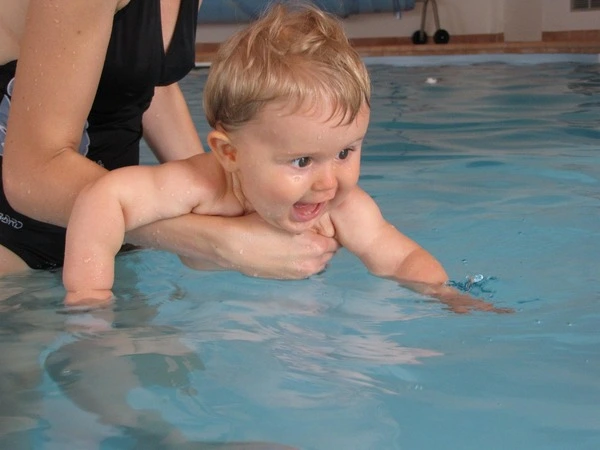
When Babies Can Swim: Key Facts at a Glance
Most pediatricians recommend waiting until your baby is at least 6 months old before swimming in a pool, ocean, or lake. The American Academy of Pediatrics advises that formal swimming lessons begin at age one.
- Why wait: Babies under 6 months are more prone to infections from pool or natural water, chlorine can irritate their skin and airways, and they get cold easily.
- Supervision: Stay within arm’s reach at all times. Babies cannot swim or float safely on their own.
- Keep it short: Limit swims to 15 to 30 minutes and watch for chills.
- Water temperature: Pools should be warm, about 89 to 94°F (32 to 34°C). Never use hot tubs with infants.
- Sun and rinse: For babies over 6 months, use baby-safe sunscreen and sun-protective clothing, and rinse or bathe your baby after swimming.
- When to stop: End the swim right away if your baby is shivering, has blue or blotchy skin, becomes lethargic or irritable, or starts coughing.
- Drowning risk: Early swimming does not remove the risk of drowning. Close supervision is always needed.
- When Can Babies Swim in Summer?
- Why Timing Matters: Developmental Milestones and Baby Swimming
- What Are the Health Risks of Early Swimming?
- Expert Guidelines: When Can Babies Swim in Summer?
- Benefits of Swimming for Babies
- Safety Precautions for Summer Baby Swimming
- When Can Babies Start Formal Swimming Lessons in Summer?
When Can Babies Swim in Summer?
Taking your baby swimming for the first time is a special milestone for many families, especially during the warm summer months. It’s only natural for parents to wonder: when can babies swim in summer—and what needs to be considered to ensure safety and fun for everyone? This comprehensive guide covers expert recommendations, developmental tips, and simple steps to help you and your little one enjoy the water with confidence.
Why Timing Matters: Developmental Milestones and Baby Swimming
Before deciding when can babies swim in summer, understanding your baby’s development is key. Most pediatricians recommend waiting until your baby is at least 6 months old before swimming in any pool, ocean, or lake. Around this age, babies typically have good head and neck control, making it safer for them to experience the water.
What Are the Health Risks of Early Swimming?
When thinking about when can babies swim in summer, consider these important health risks:
- Infections: Babies under 6 months are more likely to experience gastrointestinal infections, ear infections (otitis media), and respiratory problems from pool or natural water exposure.
- Chlorine Sensitivity: While chlorine keeps pools clean, it may also irritate delicate baby skin and airways, raising the risk of rashes or breathing issues.
- Body Temperature: Babies are less able to regulate their body temperature than older kids, making them susceptible to chills—even in warm water.
Expert Guidelines: When Can Babies Swim in Summer?
The 6-Month Rule for Baby Swimming
The consensus answer to when can babies swim in summer is after 6 months of age. The American Academy of Pediatrics (AAP) advises that swimming lessons begin at one year, but babies can be introduced to the pool at about 6 months if they have good head and neck control.
What About Chlorinated and Saltwater Pools?
Both chlorinated and saltwater pools should be avoided until your baby is at least 6 months old. Water must be properly maintained: too little chlorine increases infection risk, while too much can irritate skin and airways. Saltwater pools may be gentler but require the same careful supervision.
Important: Never allow your baby to swallow pool or ocean water, as it can lead to tummy upset or illness.
Can Babies Swim in Oceans, Lakes, or Rivers?
Experts recommend waiting until 6 months before taking babies into natural waters. Oceans, lakes, and rivers add risks such as currents, bacteria, and temperature swings. Choose calm, shallow, and clean areas—and always hold your baby close.
Benefits of Swimming for Babies
After 6 months, swimming can offer many positives for your baby:
- Enhanced motor skills and muscle strength
- Improved cognitive flexibility and visual motion perception
- Joyful water play and family bonding
- Less fear of water later in life
Important words: motor skills, bonding, child development, water adaptation
Safety Precautions for Summer Baby Swimming
Pool and Water Safety Tips
- Supervision: Practice touch supervision—always stay within arm’s reach.
- Flotation devices: Use only U.S. Coast Guard approved flotation for babies and toddlers.
- Short sessions: Keep swims brief (15–30 minutes), and watch for chills or discomfort.
- Sunscreen: For babies over 6 months, apply baby-safe sunscreen and dress them in lightweight, sun-protective clothing and hats.
- Bath after swimming: Rinse or bathe your baby to remove any chlorine or salt.
- Water temperature: Pools should be warm (about 89–94°F / 32–34°C). Never use hot tubs or cold water with infants.
Signs to End the Swim Session
End swim time immediately if your baby has any of these signs:
- Shivering or chattering teeth
- Blue or blotchy skin
- Lethargy or irritability
- Coughing, congestion, or excessive fussiness
When Can Babies Start Formal Swimming Lessons in Summer?
The AAP recommends formal swimming lessons at age one. For younger babies (6+ months), parent-baby water play classes can be a great way to help your child adapt to the water in a fun, safe setting. These classes are focused on comfort in the water, not on independent swimming.
Common Concerns and Myths
- Myth: Babies are born knowing how to swim or float.
- Fact: Babies have certain reflexes, but cannot swim or float safely on their own. They always need full adult support.
- Myth: Early swimming eliminates drowning risk.
- Fact: Drowning prevention always requires close supervision, barriers, and swimming skills—not just early exposure to water.
Quick Reference Table: When Can Babies Swim in Summer?
| Activity Type | Recommended Minimum Age | Key Considerations |
|---|---|---|
| Pool Swimming | 6 months | Head control, temperature, infection risk |
| Ocean/Lake/River | 6 months | Currents, water quality, temperature, sun exposure |
| Swimming Lessons | 1 year | Water adaptation, safety skills |
Making Baby’s First Summer Swim a Safe Success
To wrap up, the answer to when can babies swim in summer is simple: after 6 months, with careful attention to your baby’s safety and comfort. Waiting for this milestone helps your baby experience all the joys of swimming while avoiding unnecessary risks. Remember—consistent supervision, the right environment, and following your baby’s cues will lead to many happy, safe memories in the water.
Wishing you a summer full of fun, laughter, and safe splashes with your baby!
The following post may interest you
How to Protect Baby from Sun in Summer
Disclaimer: The content provided on BabyKidsHealth.com is for informational purposes only and is not intended as a substitute for professional medical advice, diagnosis, or treatment. Always seek the advice of your physician or other qualified health provider with any questions you may have regarding a medical condition.
Sources
Infant Drowning Prevention & Water Safety: How to Protect Your Baby (American Academy of Pediatrics, HealthyChildren.org)
https://www.healthychildren.org/English/safety-prevention/at-play/Pages/Infant-Water-Safety.aspx
Swim Lessons for Children: When to Start & What to Consider (American Academy of Pediatrics, HealthyChildren.org)
https://www.healthychildren.org/English/safety-prevention/at-play/Pages/Swim-Lessons.aspx
Preventing Drowning (Centers for Disease Control and Prevention, CDC)
https://www.cdc.gov/drowning/prevention/index.html
Effects of Exposure to Formal Aquatic Activities on Babies Younger Than 36 Months: A Systematic Review
https://www.mdpi.com/1660-4601/20/8/5610/pdf
Baby swimming and respiratory health
https://pmc.ncbi.nlm.nih.gov/articles/PMC2938773/pdf/nihms87646.pdf
Health risks of early swimming pool attendance
https://www.academia.edu/download/97914561/j.ijheh.2007.08.00120230128-1-19aamz7.pdf
Baby swimming: exploring the effects of early intervention on subsequent motor abilities
https://onlinelibrary.wiley.com/doi/abs/10.1111/j.1365-2214.2009.00990.x