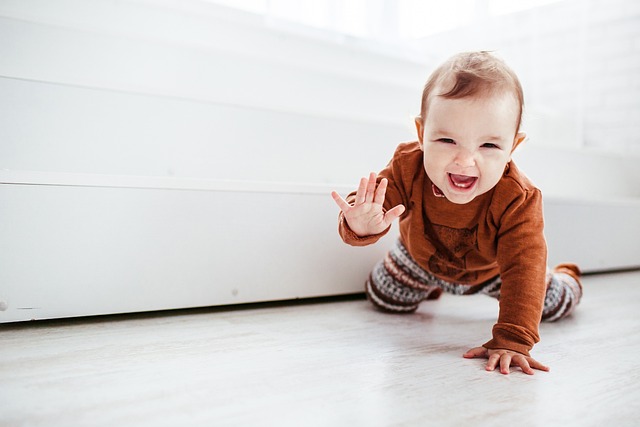
When Babies Start Crawling: Key Facts at a Glance
Most babies begin to crawl between 7 and 10 months of age. Some start earlier or later, and others skip crawling altogether and go straight to walking, which does not indicate a developmental delay.
- Signs your baby is ready: Good head and neck control, sitting up without support, pushing up on the arms and knees, and rolling over both ways.
- Crawling styles: The classic crawl on hands and knees, the bear crawl on hands and feet, the commando crawl on the stomach, and scooting on the bottom are all normal.
- How to encourage crawling: Give tummy time from birth, create a safe, open space to explore, and place toys just out of reach.
- Babyproofing: Cover electrical outlets, pad sharp corners, keep cleaning supplies and small objects out of reach, and install baby gates at the top and bottom of stairs.
- When to consult your pediatrician: If your baby shows no interest in movement by their first birthday, or does not use both sides of the body equally.
- When Should My Baby Start Crawling?
- Average Age for Crawling
- Signs Your Baby is Ready to Crawl
- Different Types of Crawling
- How to Encourage Crawling
- The Role of Babyproofing
- What If My Baby Doesn’t Crawl?
- Conclusion
When Should My Baby Start Crawling?
Crawling is an exciting developmental milestone that many parents eagerly anticipate. It’s often the first sign of your baby’s growing independence and mobility. While it can be tempting to compare your baby’s progress to others, it’s essential to remember that every baby develops at their own pace. But as a general guide, when should your baby start crawling?
Average Age for Crawling
Most babies begin to crawl between 7 and 10 months of age. However, some may start earlier or later, and others may skip crawling altogether and go straight to walking. It’s important to recognize that skipping the crawling stage doesn’t indicate developmental delays. If your baby shows interest in exploring and moves around in other ways, they are likely developing just fine.
Signs Your Baby is Ready to Crawl
There are several key signs that suggest your baby may be ready to start crawling. These include improved head and neck control, the ability to sit up without support, and the strength to push themselves up on their arms and knees. Babies who can roll over from their stomachs to their backs and back again are also showing signs that they are building the muscles necessary for crawling.
Different Types of Crawling
Not all babies crawl the same way. There are several common crawling styles:
- Classic crawl: The baby moves on their hands and knees, alternating hands and knees to propel forward.
- Bear crawl: The baby moves on their hands and feet, keeping the legs straight.
- Commando crawl: Babies use their arms to pull themselves forward while their stomachs stay on the floor.
- Scooting: Some babies sit on their bottoms and use their arms to move forward.
These variations are all normal and show that your baby is figuring out how to navigate their environment.
How to Encourage Crawling
There are several ways to help your baby prepare for and master crawling:
- Tummy time is crucial for building the strength in your baby’s arms, neck, and back muscles. You can start tummy time from birth, gradually increasing the duration as your baby grows.
- Create a safe, open space for your baby to explore. Removing obstacles and making the area safe ensures they have enough room to practice their new skills.
- Use toys as motivation by placing them just out of reach, encouraging your baby to crawl towards them.
The Role of Babyproofing
Once your baby starts crawling, it’s time to babyproof your home. Ensure that electrical outlets are covered, sharp corners are padded, and any dangerous items such as cleaning supplies or small objects are out of reach. Installing baby gates at the top and bottom of stairs is essential to prevent accidents.
What If My Baby Doesn’t Crawl?
Some babies may never crawl, and that’s perfectly fine. Many babies go straight to pulling themselves up, cruising, and walking without ever going through the traditional crawling stage. However, if your baby isn’t showing any interest in movement by their first birthday, or if they are not using both sides of their body equally, it’s a good idea to consult your pediatrician.
Conclusion
In conclusion, every baby develops at their own pace, and there’s a wide range of normal when it comes to crawling. Whether your baby crawls at 7 months or skips crawling altogether, what matters most is that they are developing other essential skills like head control, sitting up, and showing interest in exploring their environment.
The following post may interest you
How Much Sleep Does a Newborn Need? Sleep Patterns Explained
Disclaimer: The content provided on BabyKidsHealth.com is for informational purposes only and is not intended as a substitute for professional medical advice, diagnosis, or treatment. Always seek the advice of your physician or other qualified health provider with any questions you may have regarding a medical condition.
Sources
Crawling Styles (American Academy of Pediatrics, HealthyChildren.org)
https://www.healthychildren.org/English/ages-stages/baby/Pages/Crawling-Styles.aspx
Milestones by 9 Months (Centers for Disease Control and Prevention, CDC)
https://www.cdc.gov/act-early/milestones/9-months.html
Learning to Crawl:
https://srcd.onlinelibrary.wiley.com/doi/abs/10.1111/j.1467-8624.1998.tb06213.x
Developmental continuity? Crawling, cruising, and walking:
https://onlinelibrary.wiley.com/doi/abs/10.1111/j.1467-7687.2010.00981.x
The Effect of Baby Walker on Child Development: A Systematic Review: